The first racing with the VISS
It has been a busy time recently around the house, away in the van and building new rigs for the VISS, which has sat in my office for the last month, but finally I got to splash it and race it at Gosport Thursday and Sunday. Before that, a bit about the unpacking experience.
Unpacking
The hull and fittings all came in a drainage tube. Totally robust and the bits securely fastened inside. On removing all the components it was clear that this was not only a piece of art but beautifully engineered machine.
Rigging
I elected to build the rigs as I already had the masts prebent to VISS specification and found it so easy to put the shroud supports, spreaders, gooseneck and step on. The weight of each rig came out within 3 grams of each other, and without putting any further correctors the all up boat came in 7 gms underweight.


The radio pot is large and there is a waterproof section for the receiver and battery. The winch and rudder servo are easily accessible.
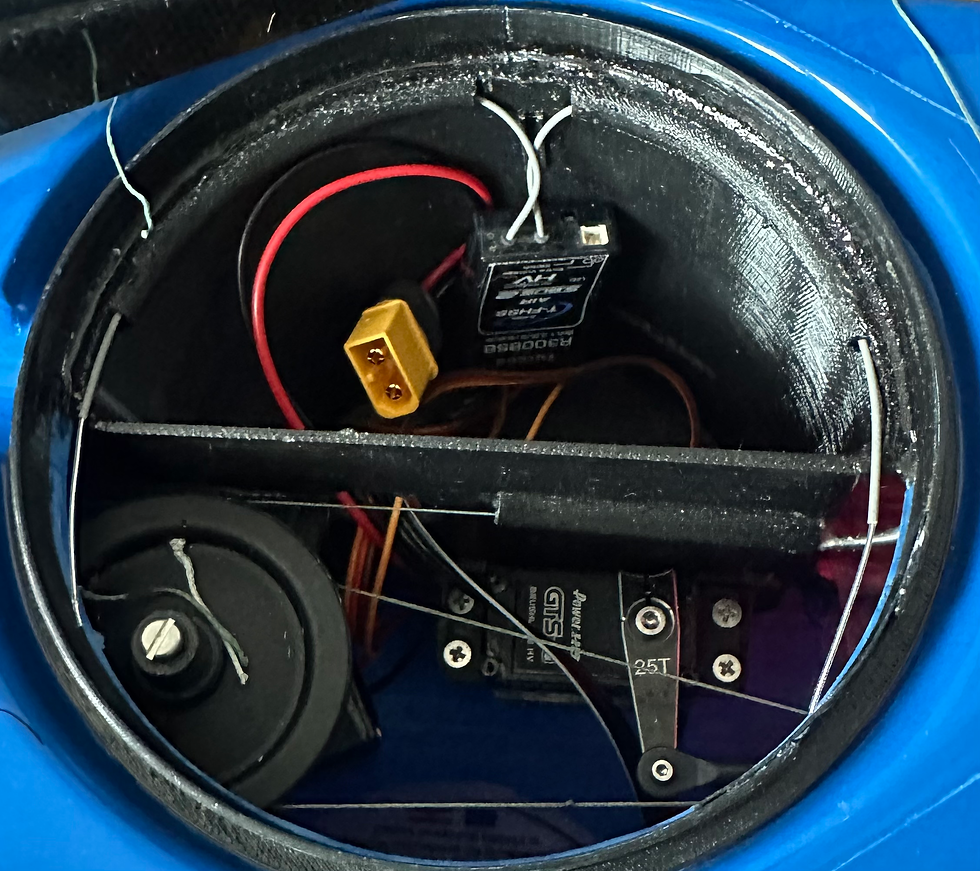
Setup
The VISS comes with a detailed setup guide with advice on how to sail the boat. I found the guide extrememely helpful and when I set the rig up to its measurements, it looked superb. Only tiny adjustments necessary when I put the boat on the water. There is a spiral winch for sensitive adjustment upwind and power gybes downwind. The guide also gives some useful tips on how to best sail the boat in various conditions.
Sailing
It is very different to the Proteus insofar as one sails the VISS with more twist and the booms are 15mm or more higher off the water which makes life more comfortable downwind as the booms don't drag in the water downwind On the Proteus I set the boat up with the mainboom 15mm out from the mainsheet post for max VMG, with tight leeches and then use mix to sheet in to a high mode when necessary. I found the VISS to be the opposite. I set up on the A rig with the main boom nearly centred and ease sheets a click at time. Bear in mind I have only sailed at Gosport so far which has flat water and shifty winds. If on open water conditions change I use the calibrated fine tuning to ease the main out 5, 10 and 15 mm from the mainsheet post, or hole in the deck in the VISS case.
The first time out I struggled with the VISS, but that might have been the result of a hangover and dehydration and a 6 hour drive the day before. On that day I hit 5 marks which prompted the comment below from one of my competitors as I was packing up after racing,
"Hey Nigel would you like a scrubbing brush to remove the mark paint you collected today."
Thankfully the marks were of light plastic so no harm done and no scratches.
Today the racing was a little more serious for my second outing. Dave was there in his V12 and Rob who sailed superbly in his Venti.
The VISS looks different and has the most volume of any IOM I have seen but the shape is logical and aerodynamic. So far, some competitors I come across, seem to find the shape not pleasing. Once I got over being told the various names for the boat we got down to racing. As the morning went on people stopped the name calling and started to look at the boat closely as it proved to be quick.
Upwind the boat was well balanced and had a great high mode. Tacking was easy with good acceleration out of the tack. It was extremely manoeuvrable around marks and accelerated well without any stalling. Downwind it was quick.
So in summary I am very pleased with the first outings and know I can get more out of the boat as I learn how to sail her. Like every boat, one has to learn the nuances which I look forward to discover.
Turning the Circle
I feel I have come the full circle. After building 2 Alternatives, I had a very competitive phase in a Britpop. Very similar to the VISS, insofar as the boat was simple to rig, a neat layout, good setup guide and fast straight out of the box. When you replaced a rig, provided all the measurements and prebend were correct, the boat performed the same. The beauty of the Britpop design is it is still a competitive package after 14 years. Hats of to Brad Gibson for producing one of the most successful designs in the IOM world and he has updated the design on his experimental boat the Post Punk and what a demon that is. It will be a great world championship next year if we see Brad, Zvonko Jelacic and Ian Vickers race against each other. Each is a designer, sailmaker and great tactical sailor. no wonder they have dominated the sport for so long.
After the Britpop, I went through a phase of experimentation with 3D printing versions of the Alioth and Proteus. The challenge I had with these designs is that I am not a designer or a good enough sailor to get the best out of them, and found it hard to spot where the correct adjustments needed to be made in terms of fin angle, weight distribution, getting the rig down to the deck. Don't get me wrong, both these designs have proved to be quick in their masters hands and the Alioth in its glass epoxy version (Polaris), has been seen near the top of leader boards in the US. I am looking forward to see a glass Epoxy version of the Proteus. If I am honest I think the challenge over the last couple of years have eroded my confidence a bit so it is good to get back to a known stable platform. If I don't get the results there is only myself to blame.
Now I have two fast boats with known setups. The VISS, a tried and tested boat with top results in the recent worlds and Europeans, and the latest Proteus. It will be fun testing the two against each other along with the Venti and the V12.
Comments